
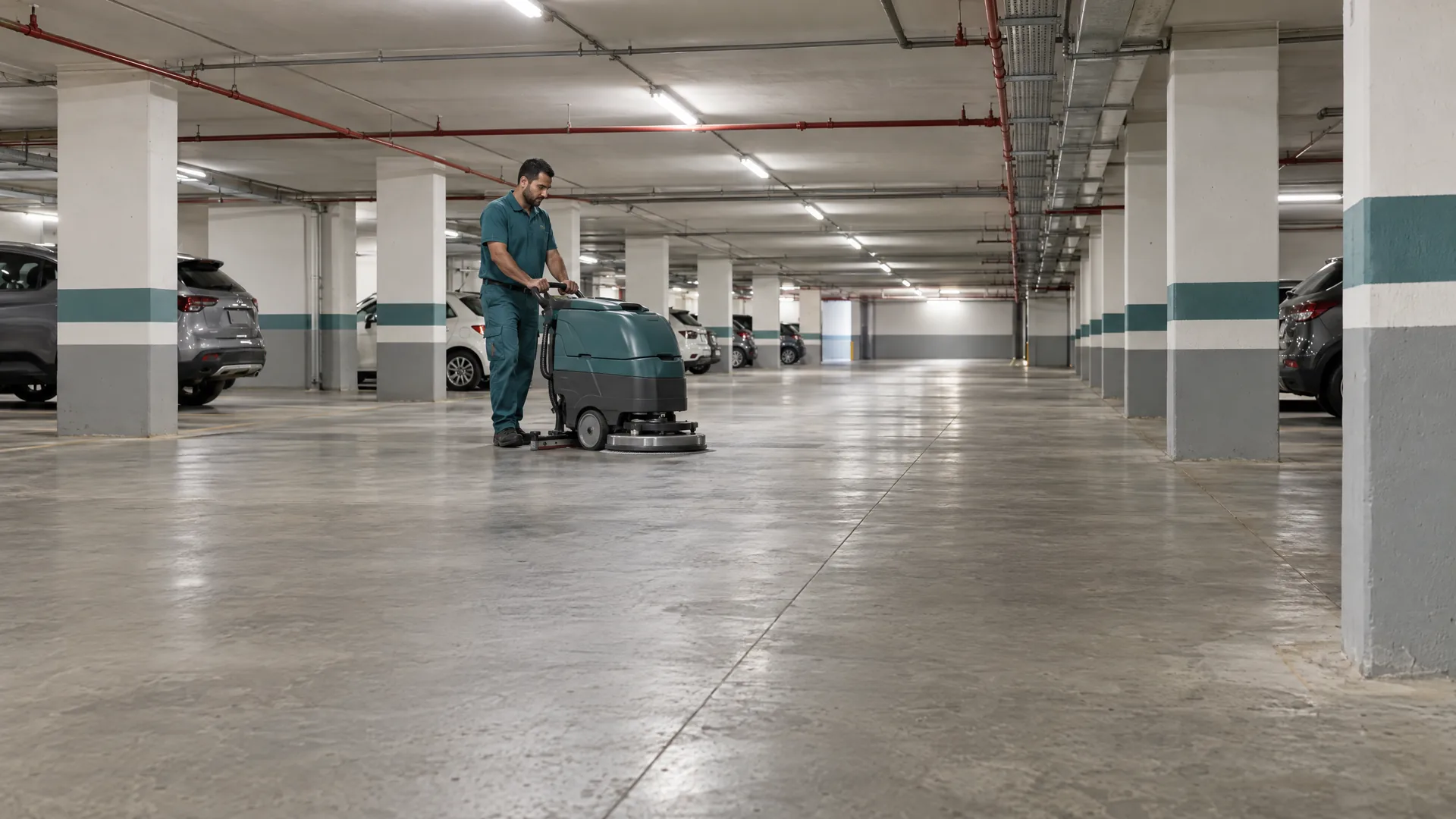
At a glance
- A well-planned clean refreshes the garage and starts with a survey of floors, coatings, stains, slopes, and drains.
- Matching scrubbing to the surface and type of soil supports effective cleaning while protecting coatings and floor markings.
- Dividing the garage into work zones and coordinating access helps residents and visitors know where to pass and what to move.
- Planning drainage, treating stains appropriately, and checking each zone help deliver an orderly result ready for safe use.
Begin with a site walk and floor survey
To refresh a garage and keep it orderly, start by understanding the site and matching equipment and methods to its conditions. Walk the levels with a building representative and identify parking areas, ramps, columns, aisles, drains, and access to gates and service rooms. Note active leaks, standing water, cracks, or loose material so cleaning can be planned separately from any underlying defect that needs repair.
Identify the surface and its condition: exposed concrete, painted or coated concrete, tile, and other flooring may respond differently to water, cleaning products, or mechanical action. Worn areas, peeling coatings, and floor markings call for an adjusted approach. If compatibility is uncertain, consult the party responsible for the floor and test a small, inconspicuous area first. This helps tailor the method to each zone.
- Map areas, floor types, slopes, and drains before defining the work scope.
- Mark dirt hotspots, oil stains, tire marks, debris, and existing hazards.
- Flag constraints in advance, such as a vehicle that cannot be moved, a leak, or a damaged surface.
Choose a treatment for the floor and soil
Floor scrubbing loosens dirt so it can be collected. Matching the method to the surface, its condition, and the soil supports efficient work and better wash-water planning. Define what needs attention—dust and sand, tire marks, general grime, or an isolated stain—since targeted treatment may be preferable to wetting a whole area.
There is no single water-pressure setting for every garage. An unsuitable force or method can damage a coating or marking, push water and dirt elsewhere, or leave the floor wet. Choose the method and product based on floor condition and product directions. If a small test indicates risk to a coating or marking, adjust the method before continuing.
Stains: set expectations before work begins
Scrubbing can reduce dirt and refresh the garage’s appearance; oil stains, tire marks, and deep discoloration may need spot treatment and may not disappear completely. Results depend in part on the surface, coating condition, how long a stain has penetrated, and previous treatments. Cleaning reduces dirt and improves appearance, while worn paint, damaged coatings, or other defects need separate attention.
Mark unusual stains in advance and ask what spot treatment may achieve. If using a cleaning product, check that it is suitable for the floor and follow its directions. The UK HSE’s guidance for cleaners recommends minimizing contact and spills, safe storage, and ventilation according to the task; it notes that some ingredients can cause irritation or harm [2]. This is general UK safety guidance, not a statement of Israeli law. Never mix cleaning products.
Sections, access, and vehicle traffic
In a garage used by residents or visitors, a clear sequence of work zones helps maintain practical, safe access. Agree which spaces need to be vacated, working hours, where people can pass, and how a closed area will be marked. Account for ramps, gates, entrances, pedestrian routes, and exits—not just parking spaces. If there is no safe alternative route, coordinate a temporary closure with the building contact and give users clear instructions.
Before work starts, name a contact for the building and one for the cleaning provider, then give drivers clear notice. If a vehicle remains or an area is blocked, pause and coordinate a new plan to keep work safe. Section-by-section cleaning can reduce disruption when the layout and access allow it; plan in advance which areas will remain available.
- Mark work-zone boundaries and temporary routes so users can see them.
- Coordinate vehicle relocation, deliveries, and access needed for building services.
- Decide who will approve reopening each section after inspection.
Drainage and wash water belong in the plan
Check floor slopes and drain locations before washing: water may collect in a corner, run down a ramp, or carry oil, mud, and cleaning product with it. Confirm with the building contact where each drain leads and how wash water should be handled, and agree what to do if a drain is blocked or an oil spill is found.
The University of North Carolina’s pressure-washing pollution-prevention guidance advises keeping debris out of storm drains and planning containment and collection when cleaning products are used [3]. This institutional guidance from the United States is not a statement of Israeli legal requirements, but it highlights a useful planning principle: check the water route and confirm that a drain is suitable. At the end of the work, check for standing water or residue that could put users at risk.
Final checks and requesting a quote
At the end of each section, check that the agreed area was covered, routes are clear, and there is no visible hazard, standing water, or residue. Mark and restrict access to a wet floor until it is dry and ready for safe use. In the United States, OSHA requires workplace floors to be clean and dry to the extent feasible and drainage to be maintained where wet processes are used; this is US safety guidance, and applicable Israeli rules and the building’s instructions also matter [1].
For a useful quote, share the approximate area, number of levels, floor types, dirt conditions, access constraints, traffic limitations, and any areas needing spot treatment. A tailored quote can account for the scope and site conditions, so it helps to share these details before scheduling. MOLO CLEAN brings more than eight years of cleaning experience. Call 0539306139 or message WhatsApp at 972539306139 to describe the garage and discuss a suitable quote.
Frequently asked questions
Can a garage be cleaned without clearing the entire facility?
Sometimes the garage can be cleaned in sections, depending on its layout, access, and method. Agree in advance which spaces will be cleared and which route will stay safe to reduce disruption.
Will scrubbing completely remove oil stains and tire marks?
Scrubbing may improve appearance and reduce stains, but complete removal cannot be guaranteed. Results depend on the surface, its condition, and stain depth. Pointing out prominent stains in advance helps identify a suitable treatment.
How do you know what water pressure to use?
Match pressure to the surface and coating, the soil, and drainage conditions. A small test and product directions help identify an effective method that protects the floor.
Sources and further reading
External sources may be available in English only.